
 Calls
Calls
 Phone numbers
 SMS
SMS
 Business Phone System
 CRM
CRM
 eSIM for Internet
 AI agent
 AI Speech Analytics
 Click to Call
 Call Tracking
 VoIP for Business
 Become a partner
 Integrations
 For whom
 Setup guides
 FAQ
FAQ
 Online chat
 Contact us
 Blog
Blog
- Key findings at a glance
- Introduction
- How much does a missed call actually cost?
- The voicemail myth
- The competitor problem
- When are calls most likely to be missed?
- Industry deep dives
- The formula: calculate your own loss
- The hidden multipliers
- What businesses can do
- Summary
- Sources & references
Key findings at a glance
- 62% of inbound calls to small businesses go unanswered
- 85% of callers who don't get through will never call back
- $126,000 - average annual revenue loss for a small business due to missed calls
- 62% of unanswered callers immediately contact a competitor
- 37% of 1-star reviews specifically cite missed or unreturned calls
Introduction
Every business owner assumes they're reachable. There's a phone number on the website, on Google Business, on the ads. But the data tells a different story.
A 2024 study by 411 Locals analyzed 85 businesses across 58 industries over 30 days and found that only 37.8% of incoming calls were answered by a live person. Another 37.8% went to voicemail, and 24.3% received no response at all — not even a voicemail option.
That means nearly two-thirds of potential customers never spoke to anyone.
This isn't just a customer service problem. It's a direct, measurable revenue loss — one that compounds month after month, largely invisible to business owners who aren't tracking it.
How much does a missed call actually cost?
The answer varies by industry, but the range is wide and consistently significant.
| Industry | Missed call rate | Cost per missed call | Annual loss estimate |
| Home services (HVAC, plumbing, etc.) | 27–62% | $275–$1,200 | $45,000–$120,000+* |
| Dental practices | 20–38% | $850–$1,300 (first year) | $100,000+ |
| Law firms | ~35% | $5,000+ per case | Varies significantly |
| Auto repair | varies | $250–$500 per job | $5,000–$10,000 lifetime/customer |
| Real estate | ~40% | $9,000 (on $300K property at 3%) | Varies |
| General SMB average | 62% | $100–$1,200 | ~$126,000/year |
* Estimated score based on Invoca data.
Sources: Invoca (home services), 411 Locals study (general SMB), Clio Legal Trends Report (law firms), Patient Prism / Weave Communications (dental), AMBS Call Center estimates.
According to research by Invoca, home service businesses alone miss around 27% of their inbound calls, with each missed call costing approximately $1,200 in lost revenue - not counting lifetime customer value.
AMBS Call Center's August 2025 analysis puts the average direct cost per missed call at $12.15 for small businesses, with the annual total reaching approximately $126,000.
The voicemail myth
Many businesses assume voicemail acts as a safety net. The data says otherwise.
- 80–85% of callers who reach voicemail hang up without leaving a message (Invoca; Dialzara, 2025)
- Only 18% of people listen to voicemails from unknown numbers (Dialzara, 2025)
Less than 3% of callers sent to voicemail during a sales interaction will leave a message, according to Invoca platform data.
In practice, voicemail is not a fallback. It's where leads go to disappear.
The competitor problem
What happens to a caller you don't answer? They don't wait. According to multiple studies:
- 62% of unanswered callers immediately contact a competitor (411 Locals / getaira.io, 2024)
- 78% of customers buy from the first company that responds to their inquiry (MIT/InsideSales.com research, via Lead Connect)
The implication is stark: in most phone-based service industries, answering first is the primary sales event. Calling back four hours later — even the same day — is typically too late.
Research by SwingPoint Media found that 37% of 1-star reviews specifically cite missed or unreturned phone calls. The damage extends beyond the lost sale into long-term reputation.
When are calls most likely to be missed?
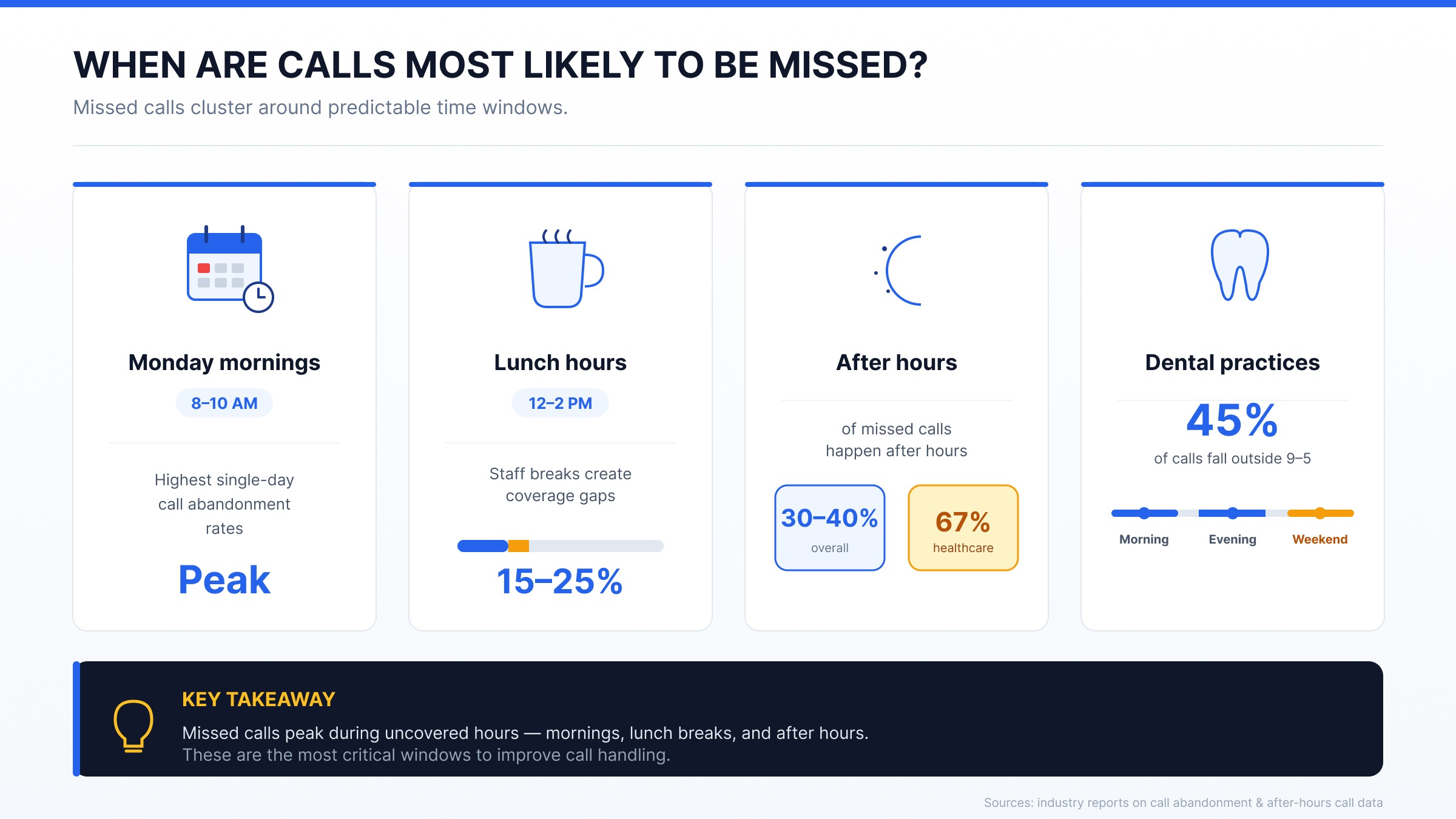
Missed calls aren't evenly distributed throughout the day. They cluster around predictable failure points:
- Monday mornings (8–10 AM): highest single-day call abandonment rates across most service industries
- Lunch hours (12–2 PM): staff breaks create gaps; abandonment rates reach 15–25% in this window alone
- After hours: 30–40% of all missed calls happen outside regular business hours (myaifrontdesk.com); in healthcare, 67% of after-hours patient calls go unanswered (Dialzara, 2025)
For dental practices specifically, 45% of calls come in outside 9–5 — evenings, early mornings, and weekends — when practices are typically closed (Ruby Receptionists data, via AgentZap, 2025).
Industry deep dives
Home services (HVAC, plumbing, electrical, construction)
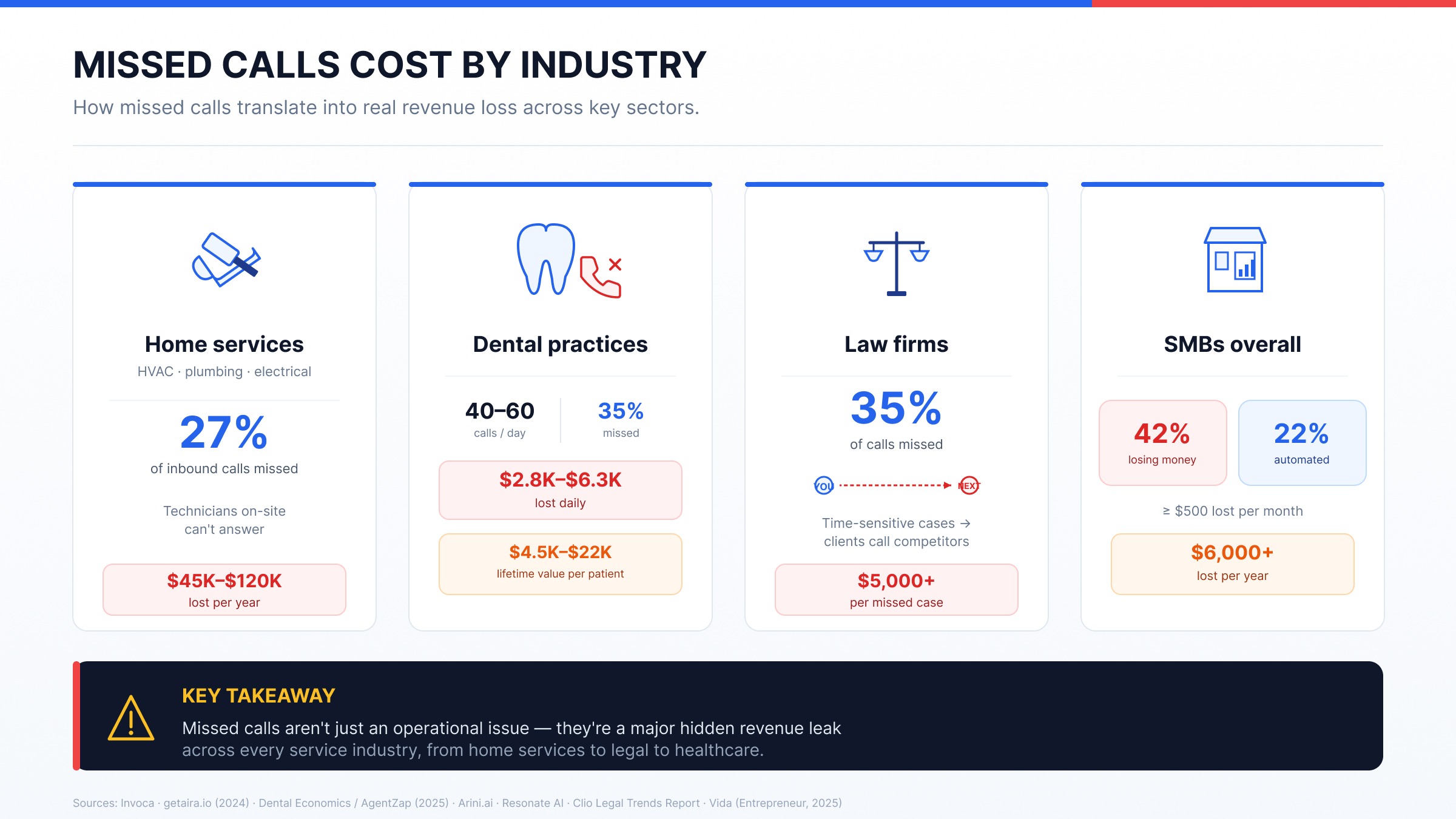
Home service businesses are among the most exposed to missed call losses. Technicians are physically on job sites, often unable to answer. According to Invoca, these businesses miss 27% of inbound calls on average — and during peak demand periods (a summer heatwave, a burst pipe in winter), that rate climbs sharply.
A contractor missing 5–10 calls per week at an average job value of $500 can lose $45,000–$120,000 per year, often without realizing it. (getaira.io, 2024)
Dental practices
Dental offices receive 40–60 calls per day on average. Missing 35% of them — a common industry figure — means $2,800–$6,300 in lost immediate revenue daily, according to Dental Economics data cited by AgentZap (2025).
Lifetime patient value makes this worse. Each missed new-patient call represents lost value of $4,500–$22,000 depending on the practice's fee schedule. (Arini.ai research)
A practice that misses just 18 calls can lose between $15,300 and $144,000 in immediate revenue alone. (Resonate AI)
Law firms
Clio's Legal Trends Report documents that law firms miss approximately 35% of incoming calls. Given the time-sensitive nature of legal matters — personal injury, criminal defense, family law — callers who don't reach a firm immediately will typically call the next firm on their list. A single missed case inquiry can represent $5,000 or more in lost fees.
SMBs overall
A survey by Vida (Entrepreneur, May 2025) found that 42% of SMBs estimate they lose at least $500 per month to missed calls — over $6,000 per year. Notably, only 22% have adopted any automated solution to address it.
The formula: calculate your own loss
The standard formula used by AMBS Call Center and similar analysts:
Monthly missed calls × Average customer value × 12 × 0.85 = Annual revenue loss
The 0.85 multiplier accounts for the 85% of callers who won't try again.
Example A — small service business: 50 missed calls/month × $500 average value × 12 × 0.85 = $255,000/year
Example B — moderate volume: 10 missed calls/month × $200 average value × 12 × 0.85 = $20,400/year
Example C — dental practice: 26 missed new-patient calls/month × $850 first-year value × 12 × 0.85 = $224,730/year
The hidden multipliers
The direct revenue loss is only part of the picture. Each missed call carries additional costs that don't appear in immediate revenue figures:
Wasted marketing spend. If a business spends $3,500/month on Google Ads to generate leads, and 62% of those leads call and get no answer, most of that ad spend generates zero return.
Lifetime value erosion. A missed auto repair customer isn't just a $250 job lost. It's a relationship worth $5,000–$10,000 in lifetime service revenue. A missed dental patient isn't a $200 appointment — it's potentially $7,500+ in lifetime value.
Referral loss. Each lost customer typically would have referred 2–3 additional prospects. (Dialora.ai, 2025)
Reputation damage. 37% of 1-star reviews cite missed or unreturned calls. Negative reviews reduce future conversion rates, compounding the original loss. 76% of consumers say they would stop doing business with a company after a single bad experience — and for many, not getting a live answer qualifies.
What businesses can do
The problem is solvable, and the solutions don't require large investments.
- Measure first. Most businesses don't know how many calls they miss because they aren't looking at call data. Cloud PBX systems and VoIP providers offer call analytics dashboards that show missed call rates, peak times, and abandonment patterns. You can't fix what you don't measure.
- Call routing and forwarding. A cloud PBX can route calls to a mobile device when staff are away from the desk, forward to a backup line during lunch, or distribute calls to available agents automatically. Tools like Zadarma’s AI Voice Agent can assist human agents with call handling and transfer callers to the right agent or department, reducing wait times and dropped calls. This eliminates many of the "no one was available" scenarios.
- After-hours coverage. Since 30–40% of missed calls happen outside business hours, Zadarma’s AI voice agent can also help by handling incoming calls, answer common questions and provide business information. Other tools such as auto-attendant (IVR) systems, callback widgets, and voicemail-to-CRM integrations can capture leads that arrive outside staffed hours.
- Callback widgets. For businesses that can't answer immediately, a callback widget on the website captures the visitor's number and allows the company to call back at a scheduled time — preventing the lead from simply disappearing. Tools like Zadarma's free Callback widget connect directly to the PBX and CRM, ensuring every request is logged and followed up.
- CRM integration. When phone systems connect to a CRM, every missed call creates a record: who called, when, from which number. This turns missed calls from silent losses into actionable follow-up tasks. Zadarma provides a free Teamsale CRM, which allows teams to manage leads, track communication history and quickly follow up on missed calls, as well as integrations with many leading CRM platforms.
The math is consistent across industries: even recovering 20–30% of currently missed calls generates revenue that far exceeds the cost of any telephony infrastructure upgrade.
Summary
The scale of the missed call problem surprises most business owners — until they measure it. Nearly two-thirds of inbound calls go unanswered. Most of those callers never try again. A significant portion immediately dial a competitor.
The average small business loses $126,000 per year to this problem, and in higher-value industries like healthcare, legal, and construction, the figure is often several times higher.
The good news is that the solutions are available, relatively inexpensive, and straightforward to implement. A cloud PBX with proper call routing, analytics, and CRM integration doesn't just reduce missed calls — it turns call data into a visible, manageable business metric for the first time.
Sources & references
| Source | Data point | Reference |
| 411 Locals (2024 study) | 37.8% of calls answered; 62% unanswered | via getaira.io |
| Invoca platform data | Home services miss 27% of calls; $1,200/call | via Invoca |
| AMBS Call Center (Aug 2025) | $12.15 direct cost/missed call; $126,000/year average | based on estimates by AMBS Call Center, as cited by Dialzara |
| Clio Legal Trends Report | Law firms miss ~35% of calls | clio.com |
| Patient Prism / Weave Communications | Dental: $850 lifetime value per missed new patient | via agentzap.ai |
| SwingPoint Media | 37% of 1-star reviews cite missed calls | via getaira.io |
| MIT / InsideSales.com | 78% buy from the first responder | via Lead Connect |
| Vida / Entrepreneur (May 2025) | 42% of SMBs lose $500+/month to missed calls | https://www.entrepreneur.com/growing-a-business/stop-losing-500-a-month-the-mistake-starts-with-a/491642 |
| Dialzara (2025) | 80% of voicemail callers hang up | dialzara.com |
| Ruby Receptionists / AgentZap (2025) | 45% of dental calls come outside 9–5 | agentzap.ai |
| Arini.ai research | Dental lifetime value $4,500–$22,000* | Arini.ai |
| My AI Frontdesk | 30–40% of missed calls are after-hours | myaifrontdesk.com |
* Varies depending on the type of practice.
This article was compiled using publicly available research data. Individual business results will vary based on industry, call volume, average customer value, and existing call handling practices.