 Calls
Calls
 Phone numbers
 SMS
SMS
 Business Phone System
 CRM
CRM
 eSIM for Internet
 AI agent
 AI Speech Analytics
 Click to Call
 Call Tracking
 VoIP for Business
 Become a partner
 Integrations
 For whom
 Setup guides
 FAQ
FAQ
 Online chat
 Contact us
 Blog
Blog
- What an AI voice agent actually is
- Why call centers are adopting AI voice agents
- Where AI voice agents work best
- What the data really shows
- The limits and risks companies underestimate
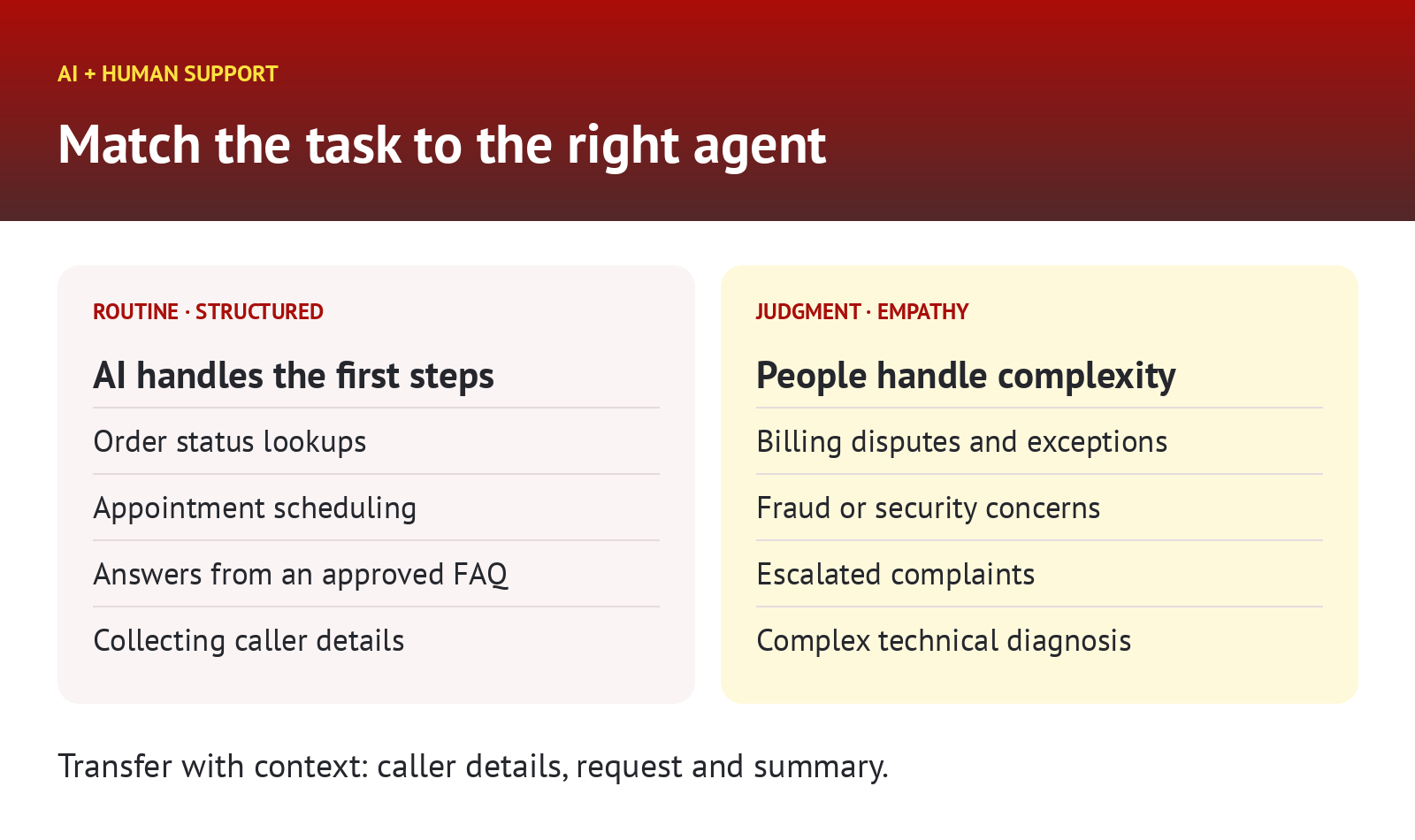
- What AI should handle vs. what humans should handle
- How to calculate the business case
- KPIs that should be measured
- A practical implementation roadmap
- Questions to ask an AI voice agent provider
- Building an AI-enabled call workflow with Zadarma
- Frequently Asked Questions
- References
A customer calls about a delayed shipment. The AI voice agent greets them in a natural-sounding voice, confirms their order number in four seconds, and gives them an accurate delivery estimate. Ninety seconds later, a different customer calls about a billing dispute involving a deceased relative's account. The same AI agent greets them just as smoothly, unable to recognize that it should stop talking and get a human on the line immediately.
That gap between what AI voice agents do well and what they do badly is the real story in contact centers right now, and it rarely makes it into the marketing.
Gartner expects conversational AI to cut contact-center labor costs by $80 billion globally in 2026, with roughly one in ten agent interactions handled without a human [1]. That number gets repeated everywhere. What gets repeated far less is the mechanism behind it: most of that saving doesn't come from AI replacing full conversations. It comes from AI handling the boring first moments of a call (name, account number, reason for calling) before a human takes over [1]. Full call automation is real, but it is the smaller slice of the number, not the larger one.
This article works through what independent, checkable data actually shows about AI voice agents in call centers: where they clearly help, where the evidence is thinner than the marketing suggests, what companies consistently get wrong during rollout, and how to build a defensible business case instead of relying on a vendor's ROI slide.
What an AI voice agent actually is
The term gets applied loosely enough that it is worth being precise, because the risks and capabilities differ a great deal between categories.
| System | How it works | Can it hold a real conversation? | Typical use |
|---|---|---|---|
| Traditional IVR | Fixed menu tree, DTMF ("press 1 for…") or basic keyword matching | No | Routing calls to departments |
| Rule-based voice bot | Scripted decision trees with limited speech recognition | Only along pre-built paths | Simple, fixed transactions (e.g., "say your account number") |
| AI voice agent | Speech recognition + a language model grounded in a knowledge base + text-to-speech, in a real-time pipeline | Yes, within the scope of its knowledge base and instructions | Answering questions, qualifying leads, booking, handling ordinary support conversations |
| Chatbot | Same underlying language-model approach, but text, not voice | Yes, in text | Website and app support, asynchronous conversations |
| Agent-assist tool | AI listens to a live human-to-human call and suggests responses or auto-fills notes | N/A: assists a human, doesn't talk to the customer | Real-time coaching, after-call summarization |
| Speech analytics platform | Analyzes recorded or live calls for sentiment, compliance, keywords | N/A: analysis only, not conversational | Quality assurance, compliance monitoring, trend detection |
The distinction that matters most operationally is between a rule-based voice bot and a true AI voice agent. A rule-based bot can only follow the paths its designer built. An AI voice agent, grounded in a knowledge base, can handle a caller who phrases a question in an unexpected way, asks a follow-up, or changes the subject mid-call. It can also confidently produce a plausible-sounding wrong answer when the knowledge base doesn't cover the question, which is a different and harder problem than a bot simply saying "I didn't understand".
Why call centers are adopting AI voice agents
The pressures pushing adoption are not new. AI voice agents are simply the latest attempt to answer them.
Call volumes remain stubbornly high even as digital self-service has expanded. McKinsey's research found that assisted (human-to-human) interaction volumes have kept growing about 2% annually since 2010, even as digital interactions grew faster, often because poorly designed digital experiences or genuinely complex issues still push customers toward a phone call [4]. Peak-load handling, after-hours coverage, and multilingual support all cost real money to staff with people around the clock. Agent attrition in contact centers is a well-documented, chronic problem, whereas AI doesn't need to sleep, take sick leave, or quit.
Manual, repetitive work is also a major driver. A large share of contact-center call time is not the actual problem-solving. It's identity verification, pulling up account details, and typing notes into a CRM afterward. McKinsey documented one energy company that used an AI voice assistant integrated into its back-end systems to cut authentication time by up to 60 seconds per call and reduce overall billing-call volume by about 20% [4]. That is a narrow, well-defined win: automate the tedious verification step with the help of an AI agent, such as Zadarma's agent, rather than the entire emotionally charged billing conversation.
The economic case is easiest to make where the workload is repetitive and unambiguous (order status, appointment scheduling, basic account questions) and hardest to make where empathy, judgment, or unusual circumstances dominate the call.
Where AI voice agents work best
Not every inbound call is a good candidate for automation. The use cases with the strongest evidence share a common shape: high volume, low ambiguity, and a clear, correct answer that exists somewhere in a knowledge base or system of record.
| Use case | Problem it solves | What AI can handle | When a human is needed | Main KPI | Main risk |
|---|---|---|---|---|---|
| Lead qualification | Slow first response to inbound interest | Basic qualifying questions, routing to sales | Complex pricing negotiation, objections | Qualified-lead rate | Sending unqualified leads to sales, wasting rep time |
| FAQ / common questions | Repetitive tier-1 volume | Policy, hours, pricing, general info | Anything not in the knowledge base | Containment rate (paired with re-contact rate) | Confidently wrong answers when knowledge base is thin |
| Order status | High-volume, low-complexity | Lookup and relay of order state | Disputes, refunds, damaged goods | Time to answer | Wrong data due to CRM sync issues |
| Appointment booking/rescheduling | Manual scheduling overhead | Calendar lookup, confirmation, changes | Complex multi-party scheduling | Booking completion rate | Double-booking from system integration errors |
| Standard information collection | Manual intake before human handoff | Name, account, reason for call | N/A: this feeds the human step | Time saved per handoff | Poor handoff if context isn't passed along |
| Call routing | Misrouted calls, long hold-based menus | Understanding intent, routing correctly | Ambiguous or multi-issue calls | Correct-routing rate | Misrouting emotionally charged calls |
| Callback requests | Abandoned calls during peak load | Capturing request and scheduling callback | N/A | Callback completion rate | Callback never actually happens (process gap, not AI gap) |
| Post-service surveys | Low response rates, cost of live follow-up | Structured, short surveys | N/A | Response rate | Sounding robotic reduces response quality |
| Reminders and confirmations | Missed appointments, no-shows | One-way or lightly interactive reminders | N/A | No-show reduction | Regulatory exposure if treated as a robocall without consent |
| Basic technical support | High volume of "have you tried…" tier-1 issues | Scripted troubleshooting steps | Anything requiring diagnosis beyond the script | First-contact resolution | Looping the customer through steps that don't apply to their case |
| After-hours call handling | No coverage outside business hours | Info capture, basic Q&A, urgent-flagging | Anything requiring real-time judgment | After-hours resolution rate | Missed true emergencies if escalation rules are wrong |
| Handoff to a human with context | Customers repeating themselves after transfer | Passing transcript/summary to the agent | The actual complex conversation | Repeat-information complaints | Handoff without context, which is the single most common failure McKinsey and others flag |
The pattern across nearly every well-supported use case: the AI is doing the first part of the interaction, or the entire interaction only when it is short and standardized. The riskier expansions, such as trying to have the AI resolve genuinely ambiguous or emotionally charged calls end to end, are exactly where the evidence gets thinnest and the vendor claims get least verifiable.
What the data really shows
It is worth separating three different kinds of claims that get blended together in most coverage of this topic: things that have been measured in a real deployment, things that are analyst forecasts, and things that are vendor-reported case studies.
Measured outcomes. The strongest single piece of evidence is the Brynjolfsson, Li, and Raymond study (Stanford Digital Economy Lab and MIT, published as an NBER working paper and covered by McKinsey), which tracked customer support agents at a company with roughly 5,000 agents using a generative AI assistant. It found a 14% increase in issues resolved per hour and a 9% reduction in handling time [2][3].
The detail that matters for planning purposes: those gains were concentrated among less experienced agents. More senior agents saw little benefit, likely because the AI's suggestions capture patterns those agents had already internalized [3]. This means the productivity case is strongest for new-hire ramp-up and weakest for your best people, which is worth knowing before promising uniform gains across a floor.
Analyst forecasts. Gartner's $80 billion figure is a forecast, not a retrospective measurement, and Gartner's own framing makes clear that partial automation (capturing intent and account details before a live handoff) accounts for a meaningful share of the projected saving, not full end-to-end automation [1]. Gartner has separately projected that by 2029, agentic AI could autonomously resolve 80% of common customer service issues. This is a further-out, more speculative forecast that should not be read as something already happening in 2026.
Vendor-reported case studies and commissioned research. Figures like "17x ROI" from a single vendor's customer story, or "391% three-year ROI" from a vendor-commissioned Forrester Total Economic Impact study, describe real methodologies (TEI studies interview actual customers and build a composite model) but are not independent industry averages. They describe how that vendor's most successful, willing-to-be-interviewed customers performed. Treat them the way you'd treat a testimonial: informative about what's possible under good conditions, not predictive of your own results.
Adoption and cost figures. Cost-per-call comparisons circulating widely (roughly $7–12 for a human-handled call versus under $1 for an AI-handled call) are directionally consistent with what a lower marginal cost of automated handling would produce. However, the specific numbers come from vendor blog aggregations without transparent underlying cost accounting, so they should be treated as illustrative rather than something to plug directly into your own budget model.
The limits and risks companies underestimate
Wrong answers delivered confidently. The core technical risk of any language-model-based system is producing a fluent, plausible, and incorrect answer, known as a "hallucination". On a phone call, this is worse than in a chat window: there's no link to click, no transcript to scroll back through mid-conversation, and the customer often has no way to sanity-check what they were just told before hanging up and acting on it. This risk scales directly with how thin or outdated the knowledge base is. A system given a narrow, current knowledge base and told what it does not know is materially safer than one given a broad, loosely scoped instruction to "answer customer questions".
Accent and speech-recognition accuracy. This is one of the most concretely documented and least discussed risks. A peer-reviewed 2020 study in the Proceedings of the National Academy of Sciences (Koenecke et al., Stanford University) tested five major commercial ASR systems (Amazon, Apple, Google, IBM, and Microsoft) against structured interviews with 42 White and 73 Black speakers across five US cities. It found roughly double the word-error rate for Black speakers, and traced the gap to the underlying acoustic models themselves rather than vocabulary differences, since the disparity persisted even on identical phrases spoken by both groups [9].
Separate academic research documents comparable disparities for non-native and regional accents more broadly, with some studies finding error rates several times higher for certain accent groups compared to standard American or British English [10][11]. This is not a hypothetical edge case. It means a poorly tuned system will systematically understand some groups of customers worse than others, with real service-quality and potential discrimination implications.
Background noise, interruptions, and latency. Real phone calls happen in cars, on factory floors, with crying children in the background. Systems tuned on clean audio degrade under real-world noise. Latency compounds the problem: research on abandonment behavior links response delays over roughly 800 milliseconds to sharply higher hang-up rates, because pauses that would be invisible in a text chat read as dead air on a call.
Privacy and call-recording law. Voice carries a materially different compliance burden than text. In the US, the FCC ruled on February 8, 2024 that AI-generated voices count as "artificial" voices under the TCPA, effective immediately, triggering prior-consent and caller-identification requirements for outbound calls [7]. A subsequent Notice of Proposed Rulemaking (September 2024) proposes going further, with mandatory in-call disclosure that the caller is speaking with AI.
At the time of writing, that proposal has not been finalized into a binding rule, and several sources note the current FCC leadership's deregulatory posture makes the timing uncertain [8]. In practice, this means the underlying consent obligation is already enforceable today, while the specific "must announce AI at the start of the call" requirement is still pending. Separately, a handful of US states, Texas among them, have already passed their own AI-voice-disclosure laws that apply regardless of what the FCC eventually finalizes, so relying on federal rulemaking status alone is not sufficient.
State-level call-recording consent laws vary: some US states require only one party to consent to a recording, others require every party's consent, and these rules apply on top of whatever national AI-specific rules exist. In the EU, GDPR treats call recordings and, per EDPB guidance on virtual voice assistants, potentially voiceprints as personal (and in some interpretations, biometric) data, meaning voice data can reveal sensitive attributes about a caller even when the conversation itself never touches a sensitive topic [12][13].
None of this is a single universal rule. It depends on jurisdiction, the nature of the call, and what data is stored, which is exactly why a company should get jurisdiction-specific legal advice rather than follow a generic checklist.
Poor handoff to humans. The single most consistently cited operational failure across both analyst and practitioner sources is a customer being transferred to a human agent who has no context, forcing the customer to repeat everything they just told the AI. This is not a hard technical problem to solve (pass the transcript and summary along with the transfer), but it is very commonly skipped in rushed deployments.
Over-automation and brand risk. Consumer research paints a consistent picture: a large majority of people still prefer a human agent, particularly for complex or sensitive issues. Automating the wrong calls may save handling time while damaging customer trust.
What AI should handle vs. what humans should handle
| Task / call type | AI suitability | Human involvement | Why |
|---|---|---|---|
| FAQ / standard information | High | Low | Structured, repeatable answers |
| Order status / appointment booking | High | Low | Clear system-of-record data |
| Basic information collection | High | Low | Routine intake before human handoff |
| Fraud / account-security issues | Low | High | High stakes, customer trust, complex verification |
| Complaint escalation | Low | High | Emotional de-escalation, non-standard resolution |
| Technical troubleshooting (complex) | Medium | Medium–High | AI handles scripted steps; diagnosis needs judgment |
| Sales objection handling | Low–Medium | High | Requires reading tone, flexible negotiation |
| Post-call documentation | High (as agent-assist) | Low | Structured summarization task, human reviews output |
The more interesting second-order effect, flagged in McKinsey's research and echoed by several analysts, is what happens to the humans once AI takes the easy calls. The pool of calls that reach a human agent becomes disproportionately the hard ones: angrier customers, more ambiguous problems, higher emotional load per call. That can raise average handling time and agent stress even while overall efficiency improves, and it changes what skills matter most in hiring and training going forward. A rollout plan that only measures cost savings and ignores this shift in agent workload composition is measuring half the picture.
How to calculate the business case
Rather than trusting a vendor's ROI percentage, build your own model from your own numbers. A simple framework:
Inputs to gather:
- Total monthly inbound call volume
- Share of calls that are repetitive/standardized (the realistic automation candidate pool)
- Average call duration, split between candidate and non-candidate calls
- Fully loaded cost per agent-minute (wages, benefits, management overhead, facilities/tools)
- Estimated AI containment rate for the candidate pool (start conservative; validate with a pilot, don't take a vendor's number)
- Transfer rate (share of AI-handled attempts that still need a human)
- Repeat-contact rate (customers who call back within 24–72 hours because the first contact didn't actually resolve anything)
- AI platform costs: per-minute or per-token charges, telephony/SIP costs, speech-recognition costs, and any knowledge-base/setup and ongoing maintenance costs
- One-time integration cost (PBX, CRM, data sources). For example, at Zadarma integrations are free.
- Ongoing quality-control cost (someone has to review transcripts and update the knowledge base)
For businesses looking to keep these components in one place, Zadarma combines cloud PBX, CRM, and AI features (including an AI agent and AI speech recognition) on a single platform, so there's no need to use and integrate separate systems.
A basic framework (not a guaranteed formula):
Monthly savings ≈ (Candidate call volume × Containment rate × Avg. minutes per call × Cost per agent-minute)
− (AI platform cost for those minutes)
− (Ongoing QA/knowledge-base maintenance cost)
− (Cost of re-work from repeat contacts caused by failed automation)
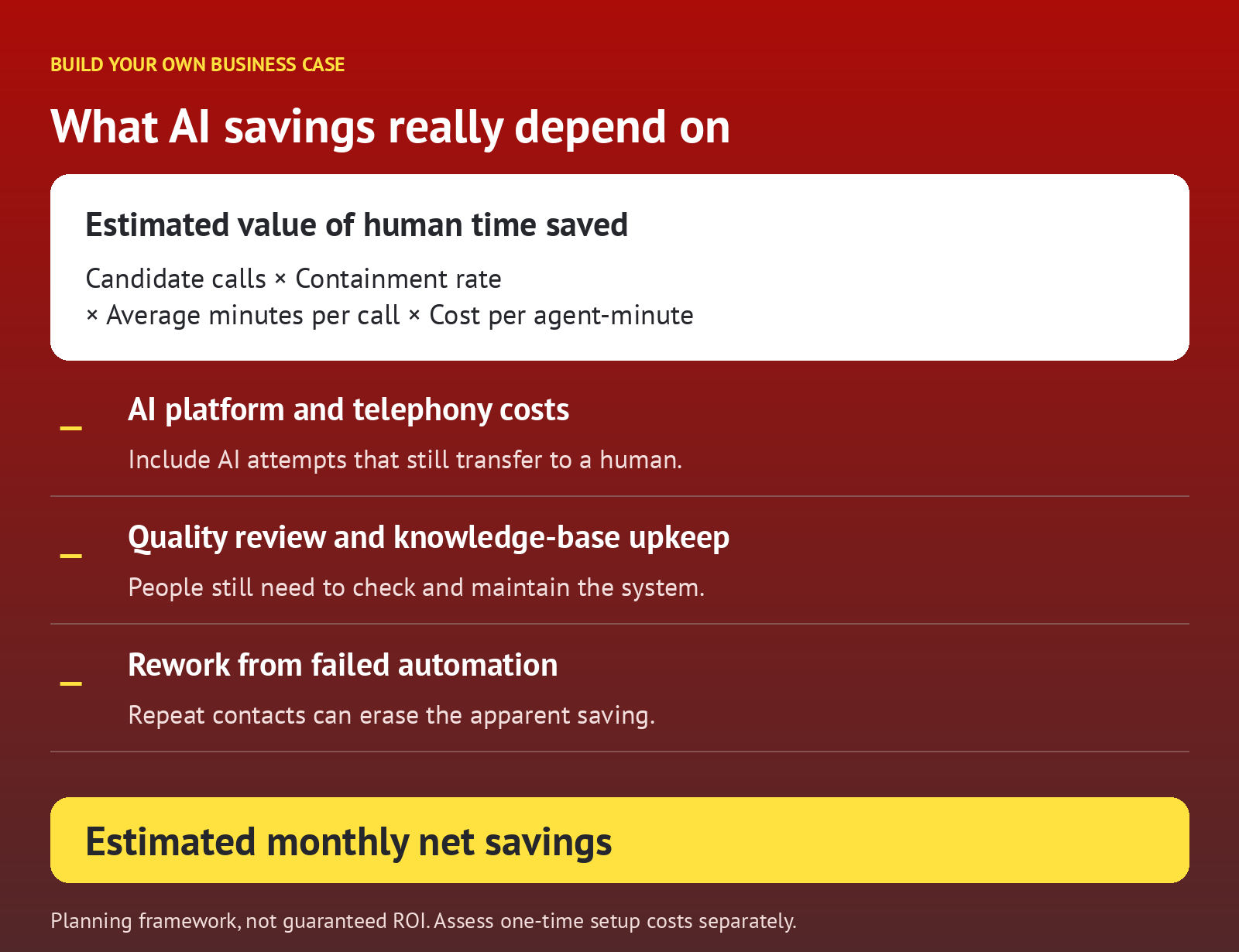
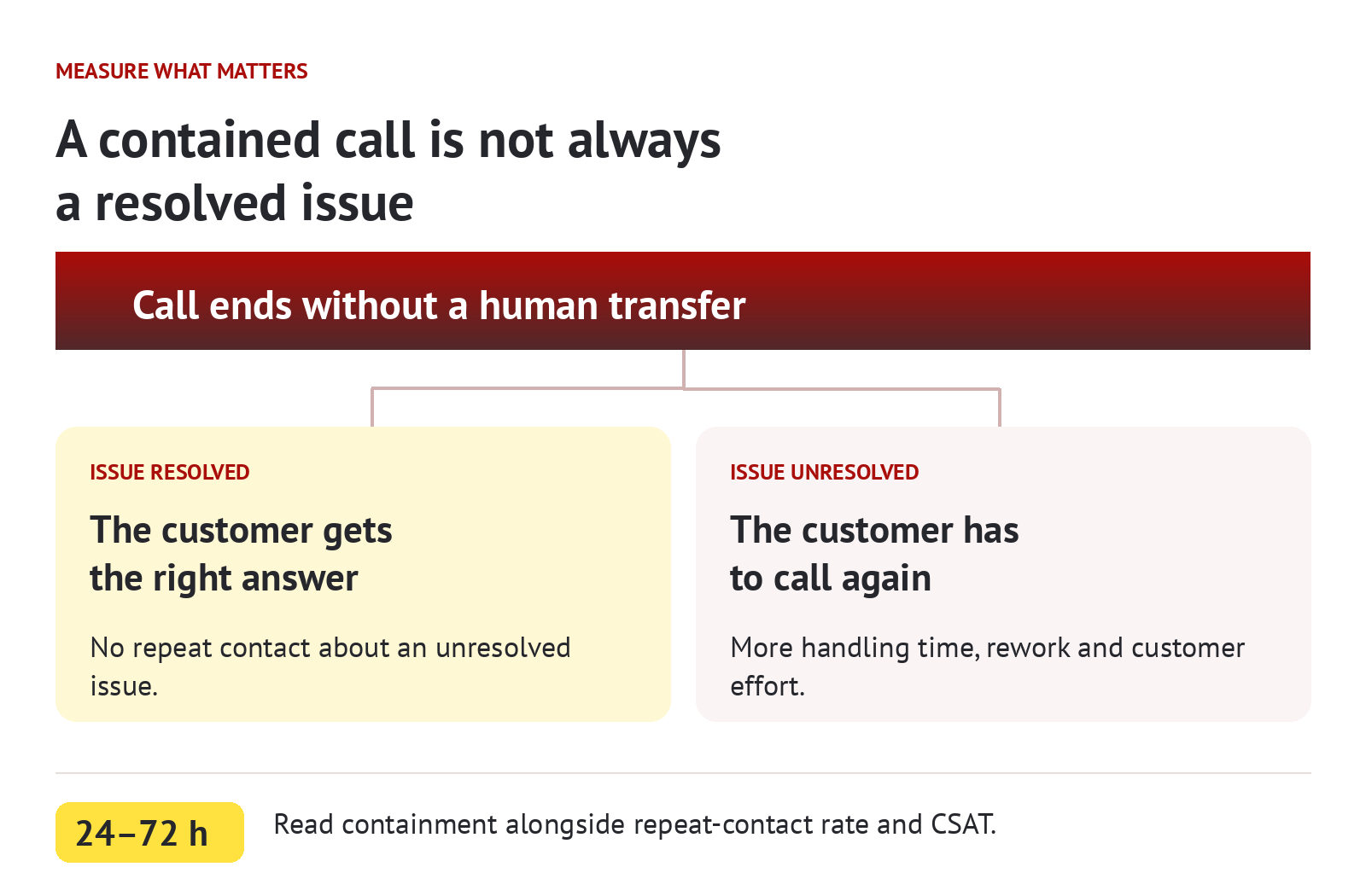
The last term is the one most business cases leave out. A "contained" call that generates an angry callback the next day has not saved money. It has probably cost more than if the call had gone to a human the first time, once you count the repeat contact and the reputational cost. Any credible ROI estimate needs a re-contact or escalation-quality check built in, not just a containment percentage.
This is a framework for thinking clearly about the trade-offs, not a guaranteed formula. Actual results depend heavily on call-type mix, knowledge-base quality, and how conservatively containment is estimated going in.
KPIs that should be measured
Operational
- Containment / resolution rate (and the gap between them: resolution means the problem was actually solved, not just that the call ended)
- Transfer rate
- Average handling time
- Time to resolution
- Call abandonment rate
- Repeat-contact rate within 24–72 hours
- Latency (response time within the conversation)
- System uptime
- Percentage of intents completed successfully
Customer experience
- CSAT
- Complaint rate
- Escalation rate
- Customer effort score
- Sentiment shift across the conversation
- Frequency of explicit requests to speak to a human
Quality and risk
- Hallucination/error rate (sampled human review of transcripts)
- Incorrect routing rate
- Failed authentication rate
- Privacy/compliance incidents
- Percentage of conversations flagged for manual review
- Knowledge-base coverage (what share of real customer questions the knowledge base can actually answer)
Business
- Cost per resolved contact
- Conversion rate (for sales-adjacent use cases)
- Appointments booked
- Qualified leads generated
- Recovered previously missed calls
- Retention/churn indicators for customers who interacted with the AI agent
A falling average handling time, on its own, proves almost nothing about service quality. A call can get shorter because the AI resolved it efficiently, or because it ended the conversation prematurely and the customer gave up or called back. Handling time should always be read alongside containment and repeat-contact rate, never alone.
A practical implementation roadmap
- Analyze call structure. Break down inbound volume by intent before choosing anything. Success criterion: a clear picture of which intents are high-volume and low-ambiguity. Common mistake: skipping this and picking a use case based on what a vendor demo showed rather than your own call data.
- Choose one narrow, safe use case. Pick something with low stakes and high structure (order status, not billing disputes). Success criterion: a use case you could explain to a customer without embarrassment if it goes wrong. Common mistake: starting with the highest-volume call type regardless of complexity.
- Record baseline metrics. Capture current AHT, CSAT, cost per contact, and abandonment for that call type before any AI is live. Success criterion: a clean "before" number for every KPI you plan to track. Common mistake: launching first and trying to reconstruct a baseline afterward.
- Prepare and verify the knowledge base. Populate and fact-check the specific information the AI will need for the chosen use case. Success criterion: a subject-matter expert has reviewed every answer the AI could give. Common mistake: pointing the AI at a general marketing FAQ instead of a purpose-built, verified knowledge source.
- Define handoff rules. Decide explicitly when and how the AI transfers to a human, and what context travels with the transfer. Success criterion: a documented decision tree, tested with edge cases. Common mistake: leaving handoff as an afterthought, resulting in customers repeating themselves.
- Connect PBX, CRM, and data sources. Integrate the systems the AI needs to actually answer questions, not just sound like it can. Success criterion: the AI can pull real, current data, not static scripted answers. Common mistake: launching with a knowledge base that isn't connected to live systems, so answers go stale immediately.
- Run a limited pilot. Launch on a small percentage of calls or a single line/number. Success criterion: a defined, small blast radius if something goes wrong. Common mistake: rolling out to 100% of a call type immediately.
- Review transcripts and failed conversations manually. Have a person read a meaningful sample of real conversations, especially the ones that failed. Success criterion: a running log of failure patterns and fixes. Common mistake: only looking at aggregate containment percentage, never actual transcripts.
- Compare against a control group or prior period. Measure the pilot against a genuine baseline, not against vendor promises. Success criterion: a real before/after or A/B comparison. Common mistake: declaring success based on containment rate alone, without checking re-contact or CSAT.
- Scale only after quality is confirmed. Expand call volume or use cases once the pilot clears its own bar. Success criterion: pre-agreed thresholds (e.g., re-contact rate under X%) actually met. Common mistake: scaling on a fixed calendar date regardless of pilot results.
- Keep updating the knowledge base and scenarios. Treat this as ongoing operational work, not a one-time setup. Success criterion: a regular review cadence with an owner. Common mistake: treating "done" as a permanent state. Products, policies, and prices change.
Questions to ask an AI voice agent provider
- Which languages are genuinely supported, and does quality vary meaningfully between them?
- What is the real, measured end-to-end response latency, not a marketing figure?
- Can the customer interrupt (barge in on) the agent mid-sentence?
- Exactly how does handoff to a human work, and what context is passed along?
- Is a transcript and conversation summary handed to the receiving agent automatically?
- What integrations exist for your specific PBX and CRM?
- Where are call recordings and transcripts stored, and for how long?
- Can you restrict the agent to answer only from an approved knowledge base?
- How are hallucinations detected and controlled? Is there a confidence threshold or fallback behavior?
- How are failed conversations identified and reported to you?
- Is your CRM natively supported, or does it require custom integration work?
- What are the full costs (telephony, speech recognition, AI/LLM usage, integration, and support), not just the headline per-minute rate?
- How quickly can the knowledge base be updated, and by whom?
- Can you use your own existing phone numbers?
- What security, access-control, and audit-log features exist?
- Can you test the agent on a small percentage of real calls before full rollout?
Building an AI-enabled call workflow with Zadarma
Zadarma is a VoIP and cloud-communications provider, founded in 2006, that launched a native AI Voice Agent as part of its cloud PBX platform in January 2026. It's a useful case study for what a bundled, telephony-plus-AI setup looks like in practice, without pretending it is the only or automatically the best option for every business.
Key features of the AI Voice Agent:
- It answers inbound calls using a natural-sounding voice, powered by LLM models from the OpenAI family, and relies on a knowledge base you provide rather than a fixed script.
- It supports 20+ languages and can detect and switch languages mid-conversation.
- It's tightly integrated with Zadarma's own cloud PBX and CRM, and can transfer calls to a specific employee, another AI agent, or a PBX routing scenario when the conversation calls for it.
- You can create multiple agents with different personalities and knowledge bases (for example, a calmer support-oriented agent versus a more energetic sales-oriented one), each tied to different phone numbers or PBX extensions.
- A website calling widget lets visitors call the AI agent directly from a browser, without a phone app or entering a phone number.
- Call analytics and full transcripts are available in Zadarma's "AI Studio" dashboard, including call counts, durations, costs, and the ability to review what was actually said on each call.
The service is available to users of Zadarma's free cloud PBX. AI-agent minutes are bundled into the paid Office and Corporation plans (100 and 200 minutes per month respectively), while the free Standard plan includes none. Additional minutes beyond any plan allowance are billed per minute, with the exact rate depending on the AI model and language chosen. Prices and included minutes can differ by region and are subject to change, so please check the current figures on Zadarma's pricing page.
Beyond its own native agent, Zadarma also supports connecting third-party voice AI platforms. ElevenLabs, Vapi, and Retell AI are explicitly documented, with detailed configuration guides provided for each, so a business already committed to one of those platforms can route calls through Zadarma's telephony rather than switching AI vendors.
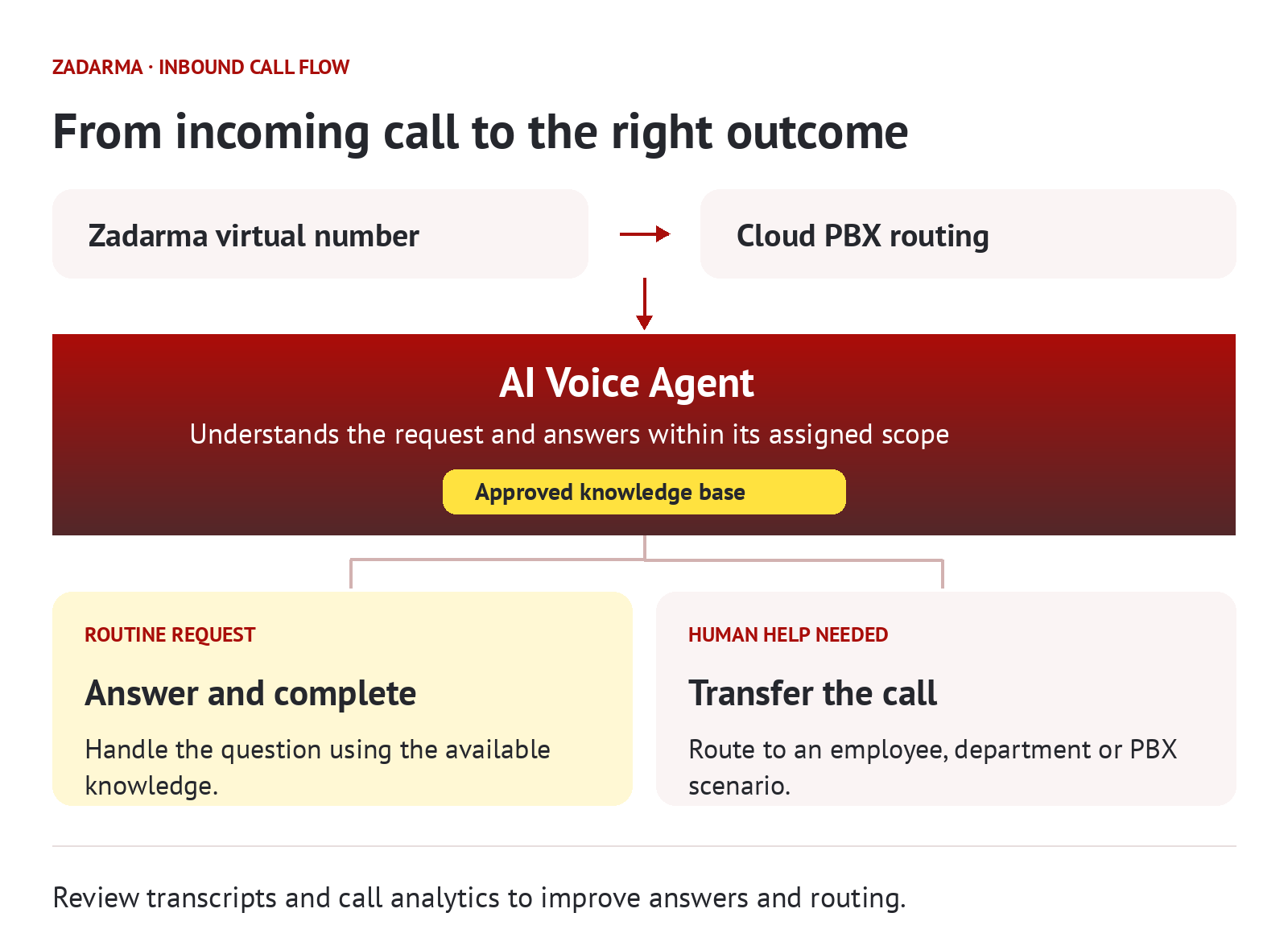
A typical inbound workflow:
- A call arrives on a Zadarma virtual number.
- Zadarma's cloud PBX routes it to the configured AI agent (native, or a connected third-party platform).
- The agent uses its assigned knowledge base to understand the request and respond.
- The conversation is logged, and a transcript becomes available in the call history.
- That data can be reviewed for quality or reflected into a connected CRM.
- If the conversation needs a human (the customer asks, or the topic falls outside the knowledge base), the agent transfers the call to the right employee, department, or PBX scenario.
When Zadarma may be a good fit. Businesses with a steady stream of repetitive inbound questions that already fit a documented knowledge base; international or multilingual teams that would otherwise need multiple native-language hires just for basic coverage; companies wanting after-hours coverage without paying overnight-shift wages; businesses that would rather have PBX, phone numbers, built-in or a third-party integrated CRM, and AI voice in one connected system instead of stitching several vendors together; and organizations that want to start with one narrow, low-risk use case before expanding.
What it doesn't remove from your to-do list. Whatever platform is chosen, the business still has to build and maintain an accurate knowledge base, define its own escalation rules for when the AI should hand off, review conversation transcripts for quality, account for local call-recording and data-privacy requirements in whichever jurisdictions its customers call from, and compare results against its own baseline rather than assuming a vendor's published numbers will transfer directly. None of that is specific to Zadarma. It's true of any AI voice agent deployment, but it's worth restating here because it's the part most easily skipped in a fast rollout.
Frequently Asked Questions
Is an AI voice agent the same thing as an IVR menu?
No. A traditional IVR is a fixed menu ("press 1 for billing") with no real understanding of natural speech. An AI voice agent understands open-ended spoken questions and responds conversationally, grounded in a knowledge base, rather than following a rigid menu tree. However, you can combine both with a VoIP system such as Zadarma.
Can AI voice agents fully replace human call center agents?
For a narrow slice of standardized, high-volume calls, yes, in practice. For anything involving genuine ambiguity, emotional complexity, fraud, or exceptions, the evidence and current regulatory environment both point toward keeping a human in the loop, with the AI handling routine work around them.
How accurate are AI voice agents with different accents?
Academic research consistently shows speech-recognition accuracy is not uniform across accents, dialects, and some demographic groups, with documented error-rate gaps in commercial systems. This is a real limitation to test for directly with your own customer base, not something to assume is solved.
Do customers have to be told they're talking to an AI?
Requirements vary by jurisdiction and are actively evolving. In the US, the FCC has ruled that AI-generated voices fall under existing robocall consent law and has proposed (not yet finalized at the time of writing) mandatory in-call disclosure. Always confirm current requirements for your specific jurisdiction and call type rather than relying on a generic answer.
What's a realistic first use case for a company just starting out?
Something narrow, high-volume, and low-stakes. Order status lookups, appointment scheduling, and basic FAQ handling are the most consistently supported starting points in the evidence.
How is ROI actually calculated for an AI voice agent?
Start from your own call volume, cost per agent-minute, and a conservative containment estimate, then subtract platform costs, ongoing knowledge-base maintenance, and the cost of repeat contacts caused by failed automation. Treat any vendor-provided ROI percentage as a best-case illustration, not a guarantee.
What KPI matters most for judging whether an AI voice agent is actually working?
No single KPI is sufficient. Containment rate paired with repeat-contact rate (within 24–72 hours) gives a much more honest picture than containment alone, because a "contained" call that generates an angry callback the next day hasn't actually solved anything.
Does adding AI voice agents make human agents' jobs easier or harder?
Both, depending on what's measured. Routine work decreases, but the calls that do reach a human become a more concentrated mix of difficult, ambiguous, or emotionally charged conversations. This shift is worth planning for in training and staffing, not just celebrating as a productivity win.
References
- Gartner, Inc. "Gartner Predicts Conversational AI Will Reduce Contact Center Agent Labor Costs by $80 Billion in 2026." Press release, Aug. 31, 2022.
- McKinsey & Company. "The economic potential of generative AI: The next productivity frontier." June 14, 2023.
- HR Dive. "AI increased customer service agent productivity by 14%, study finds." April 28, 2023, summarizing the NBER working paper by Erik Brynjolfsson, Danielle Li, and Lindsey R. Raymond (Stanford Digital Economy Lab / MIT).
- McKinsey & Company. "The contact center crossroads: Finding the right mix of humans and AI." March 19, 2025.
- Master of Code. "AI in Customer Service Statistics [2026]," summarizing a December 2025 SurveyMonkey study.
- Avaya. "45 Customer Experience Statistics for 2026." Feb. 17, 2026.
- Federal Communications Commission. "FCC Makes AI-Generated Voices in Robocalls Illegal." Declaratory ruling, Feb. 8, 2024.
- Federal Register / FCC. "Implications of Artificial Intelligence Technologies on Protecting Consumers From Unwanted Robocalls and Robotexts." Proposed rule, Sept. 10, 2024, CG Docket No. 23-362.
- Koenecke, Allison; Nam, Andrew; Lake, Emily; Nudell, Joe; Quartey, Minnie; Mengesha, Zion; Toups, Connor; Rickford, John R.; Jurafsky, Dan; Goel, Sharad. "Racial disparities in automated speech recognition." Proceedings of the National Academy of Sciences 117(14), 7684–7689, 2020.
- Del Río et al. "Accents in Speech Recognition through the Lens of a World Englishes Evaluation Set." 2023.
- "Automatic Speech Recognition in the Modern Era: Architectures, Training, and Evaluation." arXiv preprint.
- Bland AI. "GDPR Call Recording Consent: What You Need to Know to Comply." Aug. 2026.
- Ainora. "GDPR-Compliant AI Voice Agents for B2B Cold Calling (DACH 2026)," citing EDPB Guidelines 02/2021 on Virtual Voice Assistants.